
Connecting Robotics Research Across Europe: MANiBOT joins the TORNADO technical exchange
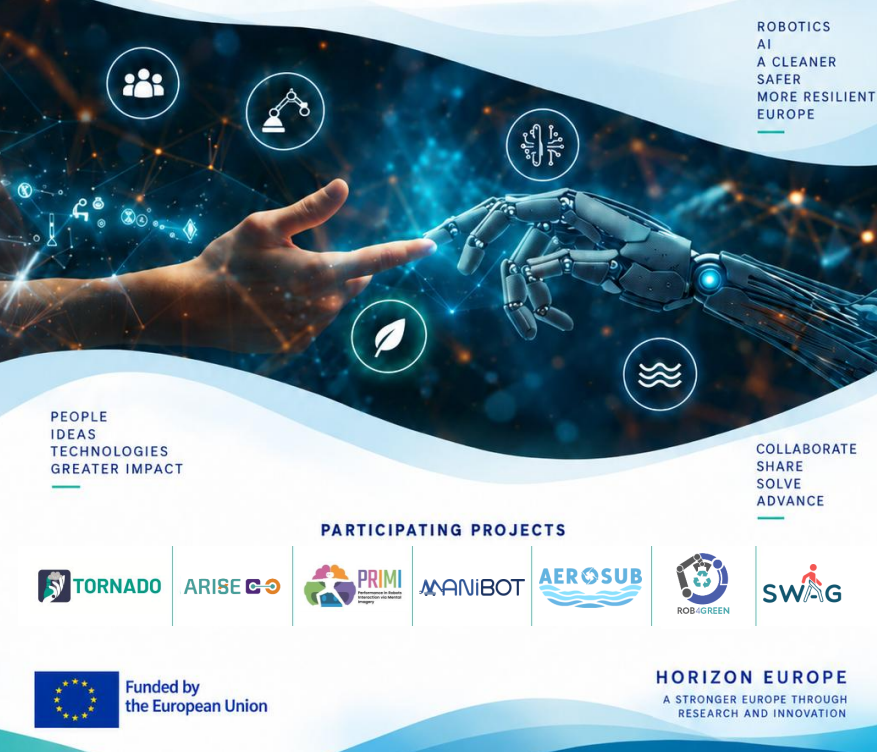
On 17 September 2026, MANiBOT joined six fellow European robotics projects for the TORNADO Technical Exchange Session – Cluster Projects Meeting, an online event created to compare technical approaches, discuss common challenges and identify opportunities for knowledge exchange.
The session brought together TORNADO, PRIMI, MANiBOT, AEROSUB, ROB4GREEN, ARISE and SWAG. While the projects operate across different sectors and environments, their presentations revealed many shared robotics challenges: how robots can better perceive changing surroundings, manipulate difficult or unfamiliar objects, adapt their actions when conditions change, work safely around people and move from individual technologies towards reliable integrated systems.
Different applications, similar technical challenges
TORNADO opened the exchange with its work on adaptive, perceptive and safe robotic manipulation, including the handling of small, soft, deformable and unconventional objects.
Across the presentations, a recurring challenge was how robots can move beyond rigid, predefined manipulation strategies. Real-world environments are unpredictable: objects vary in shape, weight, material and position, surroundings change, and human workers may share the same operational space.
Robots therefore need to combine perception, sensing, decision-making and control to continuously adjust what they do according to the situation they encounter.
These questions are closely aligned with MANiBOT’s ambition to advance the physical intelligence of robots towards more human-like object manipulation.
MANiBOT’s contribution to the exchange
MANiBOT was represented by Dimitra Triantafyllou from CERTH, who presented the project’s approach to enabling mobile bi-manual robots to manipulate a wide variety of objects in dynamic environments.
MANiBOT brings together multimodal perception, cognition and control, tactile and proximity sensing, advanced manipulation strategies and human-aware robot operation. A central challenge is enabling robots to work with highly diverse and partially or fully unknown objects while adapting their behaviour according to the sensory information they receive.
These technologies are being integrated and validated through two demanding application areas: supermarket shelf restocking and airport baggage handling.
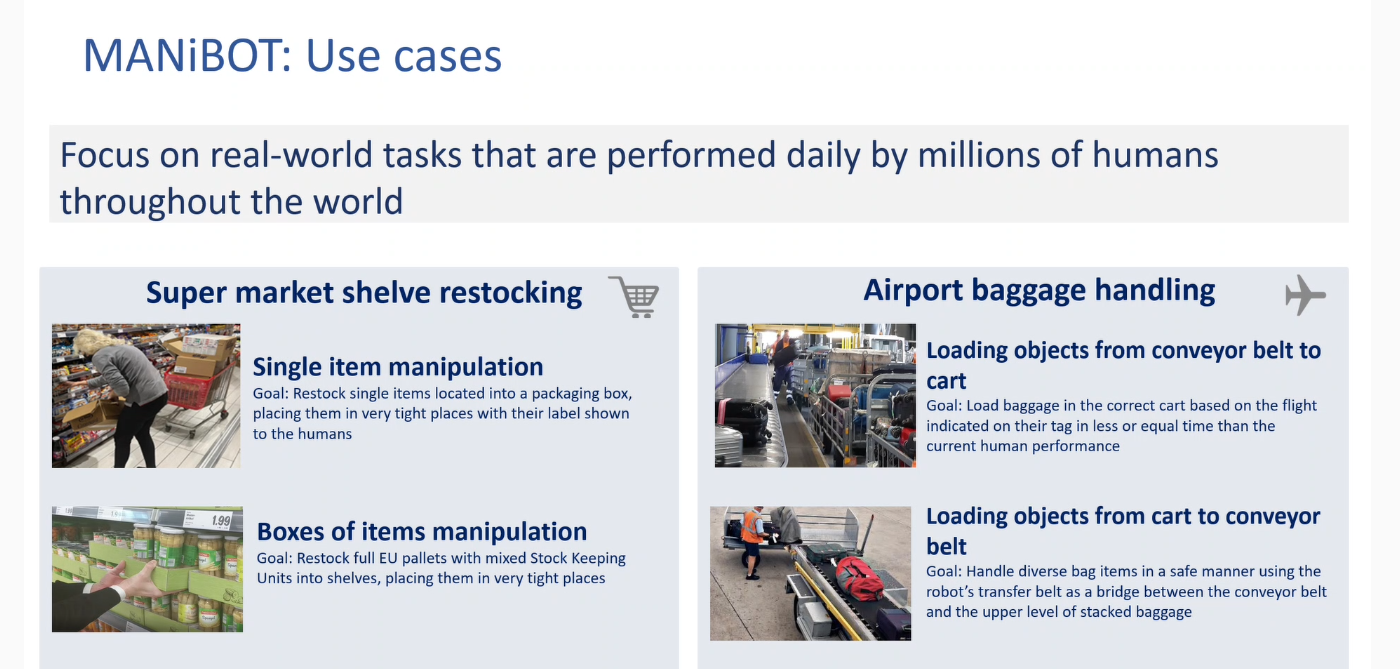
In supermarkets, robots need to identify, grasp and place products with very different shapes, sizes and packaging while operating in environments shared with people. In baggage handling, they must deal with luggage that can vary significantly in geometry, weight, material and positioning.
Both environments therefore provide realistic tests of a robot’s ability to perceive its surroundings, select appropriate manipulation strategies and respond when real-world conditions differ from what was expected.
From sensing to adaptive manipulation
One particularly relevant area of exchange was the role of sensing and feedback in adaptive manipulation.
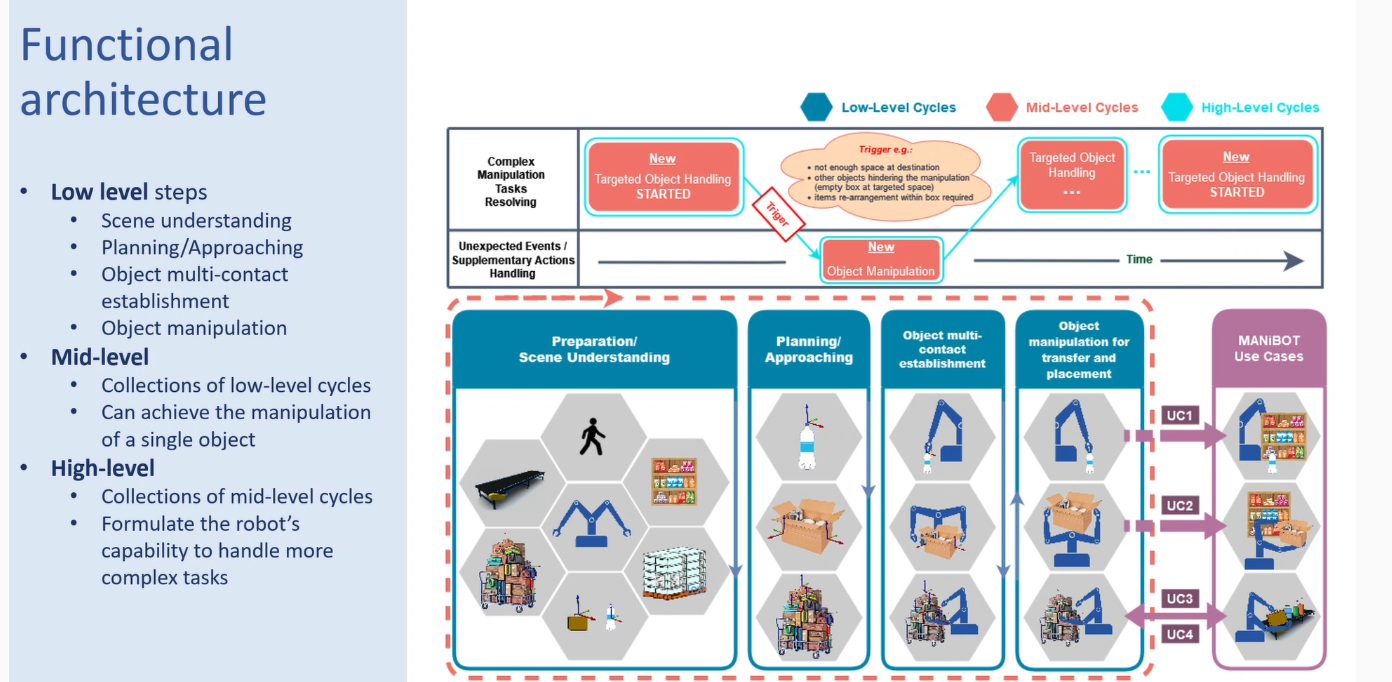
Rather than relying only on visual information or predetermined robot motions, advanced robotic systems need to interpret information gathered during physical interaction with objects. This allows the robot to adjust its actions based on what is actually happening during the manipulation task.
The discussion led to a concrete follow-up between MANiBOT and TORNADO around force-sensing manipulation methods, with relevant MANiBOT publications to be shared with TORNADO researchers after the session.
This is exactly where cross-project technical exchanges add value: similar challenges may be approached from different technological perspectives, creating opportunities to compare methods, learn from one another and identify complementary solutions.
From individual technologies to integrated systems
The session also highlighted a broader challenge shared across advanced robotics research: promising individual technologies must ultimately work together as part of a complete robotic system.
For MANiBOT, perception, sensing, planning, control and manipulation all need to operate together while the robot is mobile, interacting with diverse objects and potentially sharing its environment with people.
Testing these capabilities in realistic supermarket and airport scenarios is therefore not only about demonstrating individual technologies, but also about understanding how they perform when combined under the variability and uncertainty of real-world operation.
Cross-project exchanges can support this process by allowing researchers to compare integration strategies, discuss technical limitations and share lessons from validation.
Strengthening robotics collaboration across Europe
Participation in the TORNADO Technical Exchange Session forms part of MANiBOT’s wider effort to connect with related European research and innovation initiatives and strengthen knowledge exchange across the robotics community.
By bringing together projects tackling related challenges from different sectors and technical perspectives, exchanges of this kind can help identify complementarities, share lessons learned and create opportunities for continued collaboration.
For MANiBOT, they also offer a valuable opportunity to connect its work on bi-manual manipulation, multimodal sensing and physical intelligence with the wider European effort to develop more adaptable, autonomous and human-aware robotic systems.