
Proximity Detection Sensor for Human-Robot Collaboration
The proximity detection sensor is designed to allow robots to perceive the presence of nearby objects or people before physical contact occurs. By continuously monitoring changes in its immediate surroundings, the sensor enables early awareness of proximity and supports timely and appropriate robot responses. Within the MANiBOT project, this capability contributes to the development of redundant and robust perception strategies, complementing vision- and lidar-based sensing to address the challenges posed by unstructured, human-populated environments. Notably, capacitive proximity sensing does not require a direct line of sight, allowing it to operate through compliant and protective layers and to effectively complement exteroceptive sensing modalities in target perception.
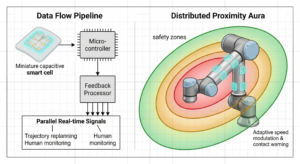
During development, several alternative approaches were explored to identify a solution best suited for collaborative robotic applications. The focus was on achieving reliable detection, robustness in real-world environments, and compatibility with different robotic use cases, including logistics and manipulation tasks in shared human–robot workspaces. The selected solution demonstrated strong overall performance and was successfully integrated into a robotic platform, where it enabled effective human presence detection and interaction during manipulation tasks. In the MANiBOT context, the sensor supports the creation of a proximity “aura” around the robot, enabling anticipatory collision avoidance, adaptive speed modulation, and improved reaction times in compliance with current safety regulations. By providing fast, local, and line-of-sight-independent feedback, the proximity sensing unit improves human–robot interaction and enhances safety in close-range and dynamic collaborative scenarios.
The sensing unit was conceived to address both functional performance and usability requirements. Key objectives included ease of integration, adaptability to different robot configurations, and scalability of both sensing dimensions and coverage, allowing the unit size, shape, and density to be adjusted according to the area to be covered and the geometric properties of the robotic surface. The design supports encapsulation within compliant and protective materials, such as silicone, enabling safe physical interaction, environmental protection, and seamless integration without affecting sensing performance. Particular attention was given to supporting safety and collision avoidance, enabling retrofitting on existing robotic systems, ensuring robustness in diverse operating conditions, and maintaining cost-effective and compact integration. The sensor also supports both contact and non-contact interaction while providing fast and responsive behaviour, contributing to a shorter perception–action loop and enabling higher operational speeds when humans are at a safe distance.
The final solution results in a modular and scalable proximity sensing unit, conceived as a smart and cost-accessible cell for retrofitting in collaborative robotics. The sensors are intended to be deployed on-board the robot, covering limbs through a modular robotic-skin architecture and integrating at the gripper level to ensure dense sensing coverage in the end-effector area. This distributed deployment enhances both safety and usability by enabling consistent proximity awareness across the robot body and during manipulation tasks. The sensor fits naturally within the broader MANiBOT system architecture, supporting the integration of proximity and tactile sensing into parallel processing pipelines for real-time feedback, trajectory replanning, and human motion monitoring, while providing a practical and extensible foundation for proximity-aware robotic systems operating in shared human environments.