
MANiBOT Innovations Feature at European Robotics Forum 2025
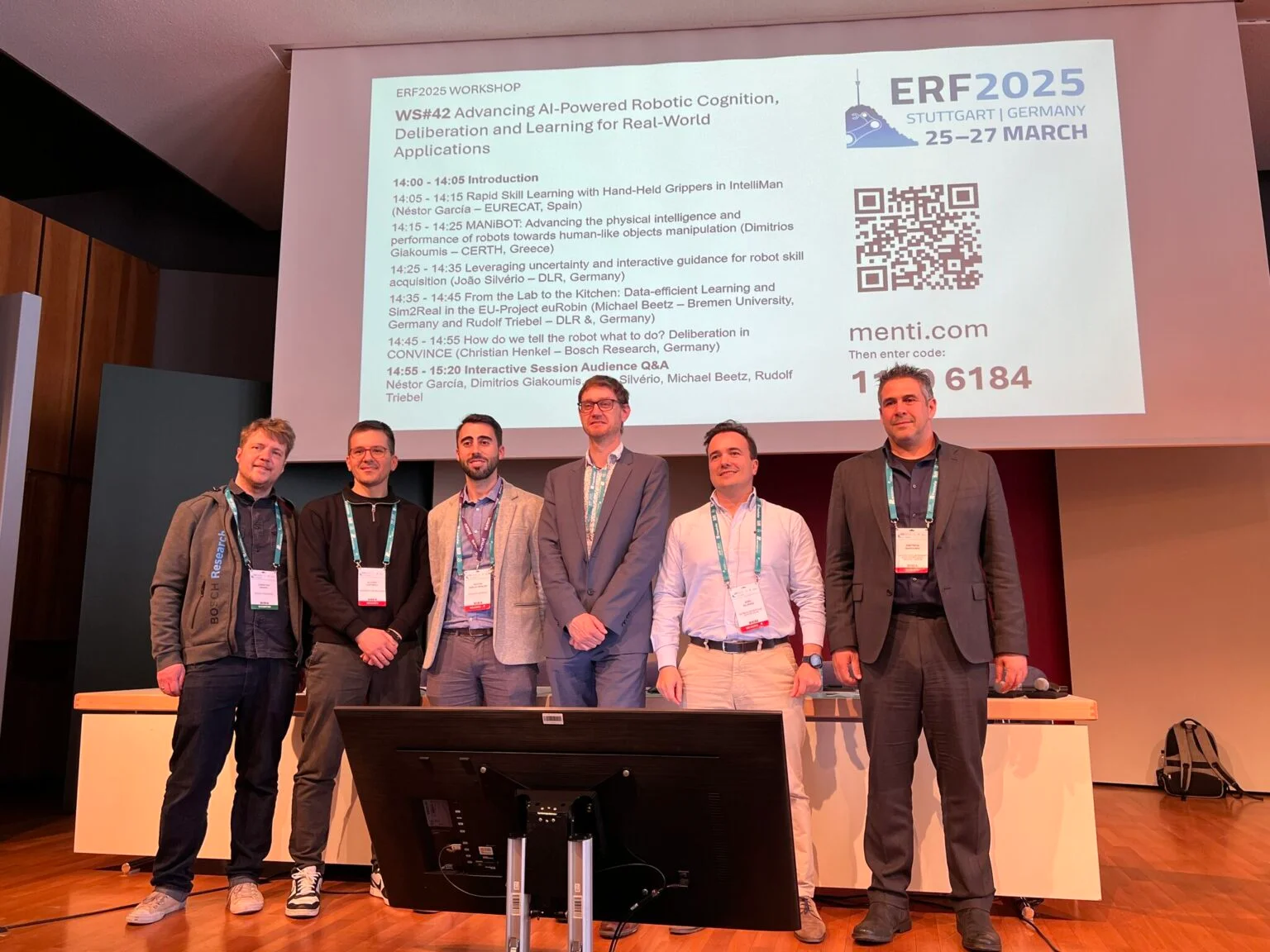
Robotics experts gathered to explore the future of physical intelligence as MANiBOT joined leading projects at the European Robotics Forum 2025 workshop “Cognitive Robotics and AI-Powered Systems for Real-World Applications”.
The workshop, co-organised by CERTH (Centre for Research and Technology Hellas) on behalf of the consortium, brought together leading experts in cognitive robotics on the 27th March. Presentations and discussions explored advanced methods for defining robotic behavior, with particular emphasis on deliberation, adaptability, and practical real-world applications.
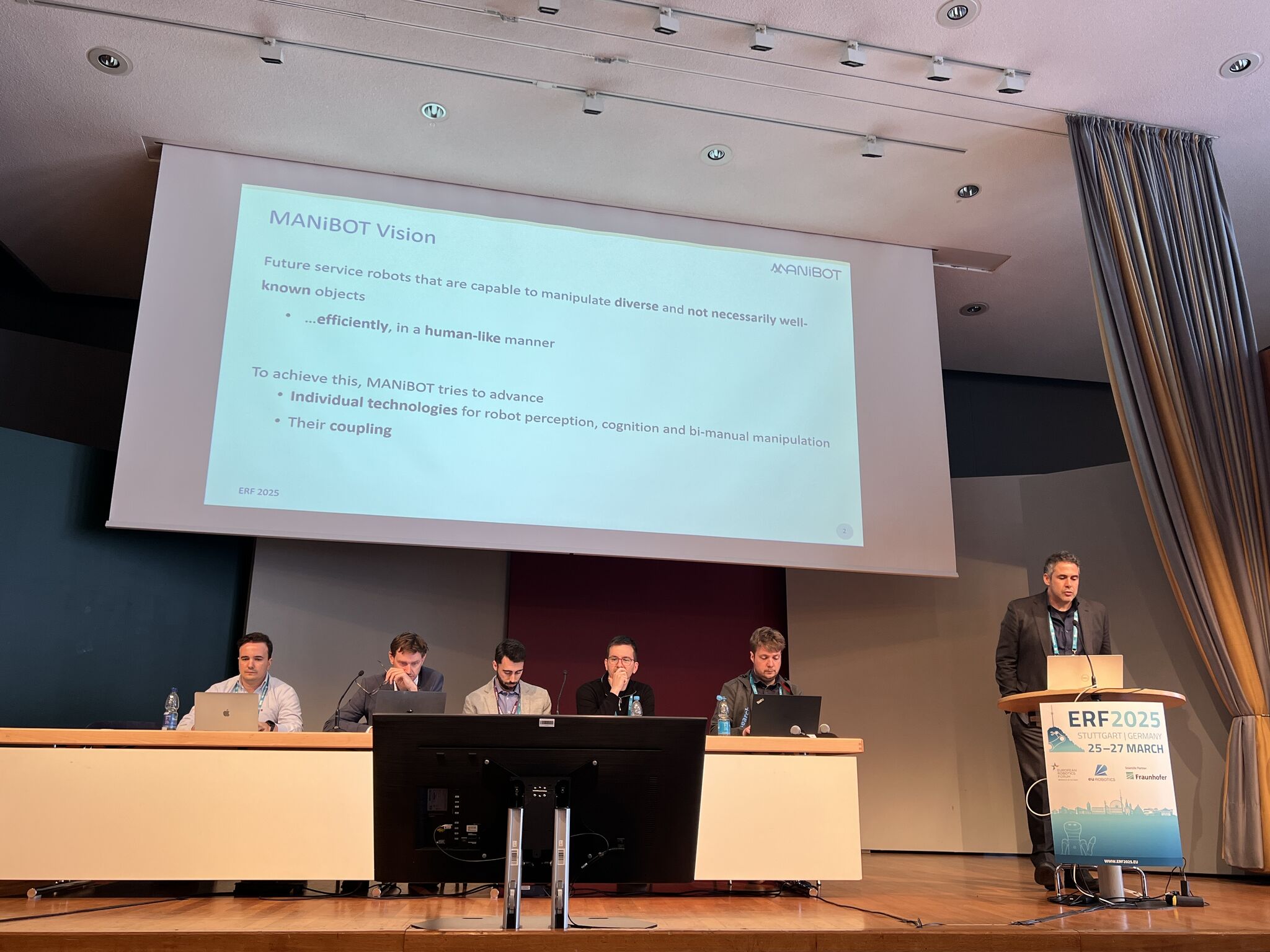
Dr. Dimitrios Giakoumis presented MANiBOT’s innovative approaches to physical intelligence and human-like object manipulation. He highlighted the cobot’s adaptive multi-level robot cycles approach, which enables robots to handle complex manipulation tasks with diverse objects in challenging environments.
The workshop featured contributions from several other prominent EU-funded projects, including Intelliman, Rapid Skill Learning with Hand-Held Grippers (www.intelliman-project.eu), CONVINCE, How we tell the robot what to do? (www.convince-project.eu), PILLAR-Robots (www.pillar-robots.eu), and euROBIN – Data-efficient Learning and Sim2Real (www.eurobin-project.eu).
Collaborative discussions among the 50+ audience focused on essential aspects of robotic deliberation, data-efficient learning, Sim2Real transfer techniques, semantic sensor fusion, and control theory applications.
During the Q&A session, polling results revealed that workshop participants identified “Software and AI efficiency and adaptability” as the greatest challenge for enabling rapid skill learning in robotic manipulators. For robotic object manipulation systems handling diverse objects, similar concerns emerged.
The interactive polling also showed that attendees favored “Real-time corrections/feedback during execution” and “Demonstrations” as the most practical forms of human input for helping robots adapt to dynamic environments, while Behavior Trees emerged as the preferred tool for robotic deliberation.
These exchanges fostered valuable cross-project insights on addressing both challenges and opportunities in cognitive robotics, contributing to the collective goal of advancing AI-powered robots for dynamic, real-world applications across diverse domains and environments.
To learn more about the workshop and access the presentations, please visit the workshop webpage here: https://lar-unibo.github.io/erf2025_ws42/